Daily Note (6th August 2026)
An update on the selection function analysis - I was trying to go from an r-band selection to a K-band selection (which is less impacted by dust and therefore easier to convert into a selection function in physical property space, with the naive intuition that the SEDs will roughly just scale with the stellar mass as an overall normalization and the 'tilt' mainly coming from the sSFR and dust. Turns out (and seems rather obvious in hindsight because it determines how systems can cool), metallicity plays the dominant role and without accounting for it, there's a huge amount of scatter in converting the flux to . The other interesting thing is that the scaling with metallicity does not seem to be linear, so a simple linear fit of the sort only works to an extent. This means that while we can (roughly) analytically convert the r-band selection into a K-band selection (and thus to a stellar mass selection), it's not as straightforward as I'd initially envisoned.
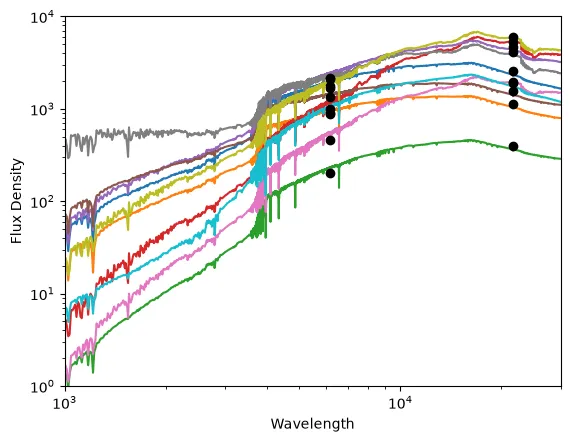
So for the SDSS r-band selection of , this translates to , which at comes out to roughly . With the rough linear approximation, this then becomes
which can then be converted into a limit using a K-band ratio.